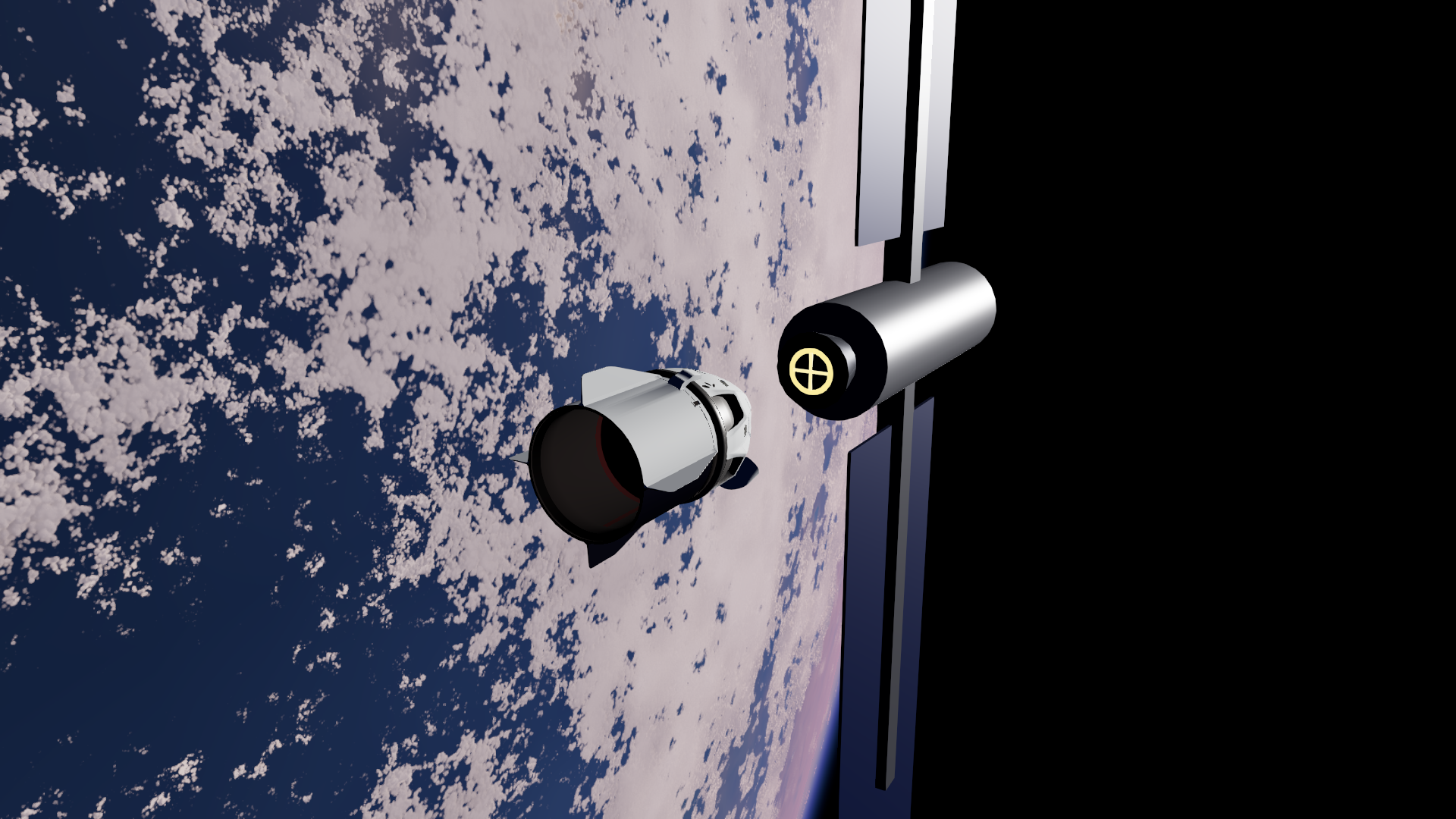
Guidance · Navigation · Control
Aerospace engineer focused on GNC after four years building flight hardware and test equipment at Lockheed Martin.
Now developing spacecraft simulation and autonomous perception systems. Current Top Secret clearance. U.S. citizen.
Scroll ↓Featured work · Guidance, navigation and control
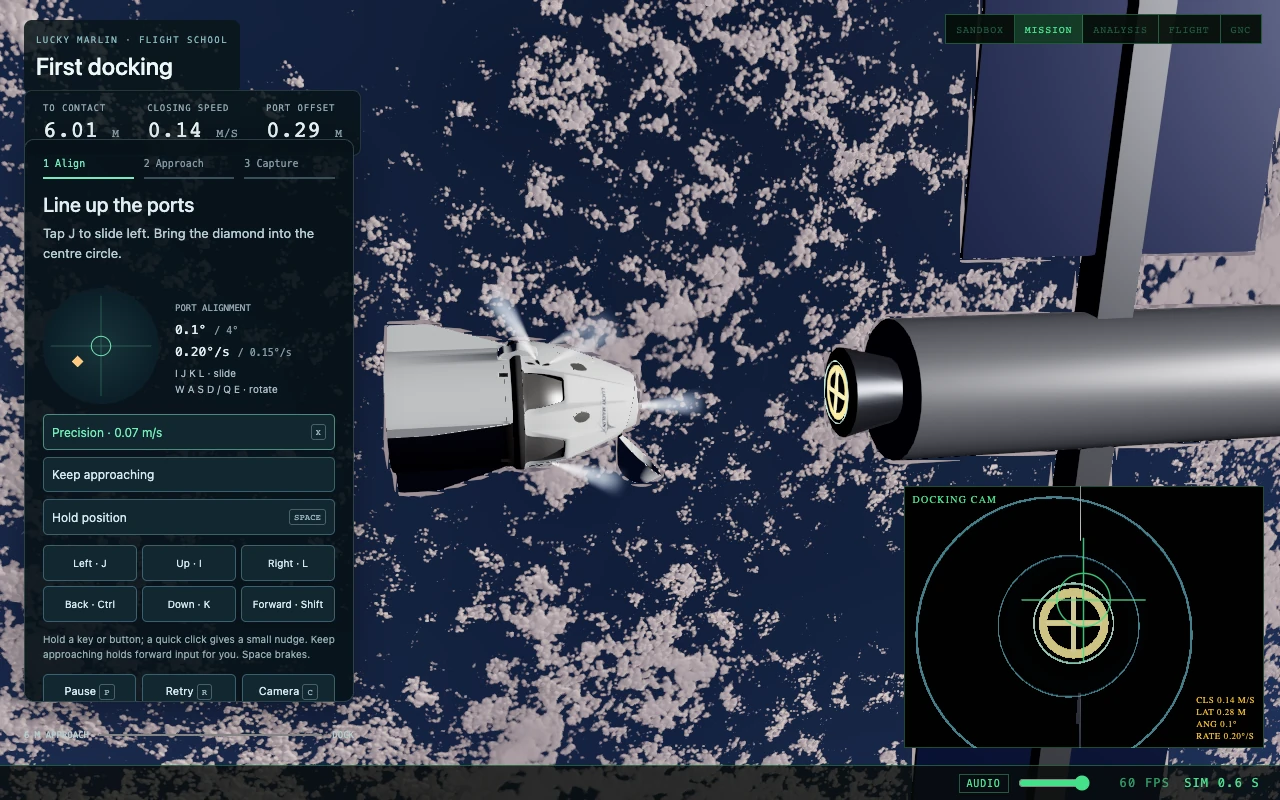
I developed a MATLAB/Simulink spacecraft dynamics model and an interactive docking simulator, comparing their responses during normal operation and thruster failures. The simulator connects six degrees of freedom, navigation and feedback control to a mission you can watch or fly.
Exact Simulink and native MATLAB agreement in each case.
Comparison results ↗Normal operation and a stuck-open thruster followed by isolation.
Case conditions ↗Deterministic plant integration with analytic and conservation checks.
Verification record ↗Offline deterministic plant verification, not real spacecraft validation or a live MATLAB link.
Source code and documentation →
Solid arrows: existing paths. Dashed arrows: unfinished integrations.

Status applies to the scope of each block. The current renderer and offline MATLAB model are complete; Volumetric Weather is in progress. Live MATLAB / SIL / HWIL integration and remote Runpod execution remain planned.
Featured work · Autonomous driving · CMPE 249
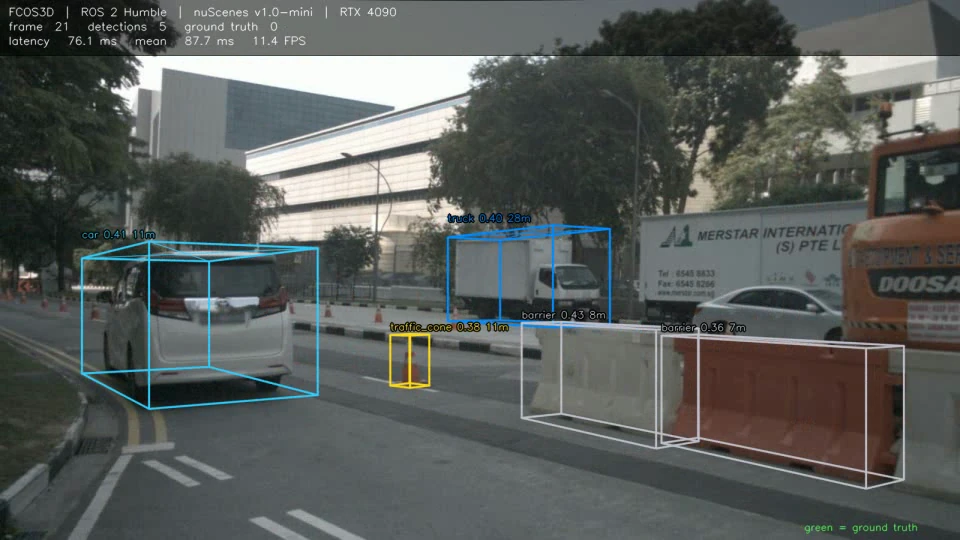
I built a ROS 2 pipeline that detects cars, pedestrians and other objects in 3D using a pretrained FCOS3D neural network and public nuScenes driving data. The work focused on getting the model’s outputs into the right coordinate frame, measuring performance and understanding where perception breaks down.
Correcting output decoding and camera calibration made the performance comparisons useful. The brightness sweep showed where single-camera detections become unreliable; regression tests now cover the fixes.
Experience
Sunnyvale, CA · Flight hardware
Drove flight hardware mechanical design, qualification test fixture development, product definition, and drawing release. Flowed top-level requirements from Systems, RF, manufacturing, and quality into mechanical and electrical documentation.
Maintained flight and GSE drawing sets through Windchill change tasks. Owned BOM documentation, vendor coordination, and DFM feedback; tracked long-lead items against build schedules.
Incorporated engineer redlines and GD&T corrections into drawings and processed change requests through engineering release.
Earlier work
Co-designed the 3U mechanical frame and printed payload panels; programmed the Arduino payload to log and transmit temperature, pressure, CO₂, humidity, and GPS through a 10,000 ft rocket flight.
Simulated a tapered NACA 4412 half-wing in STAR-CCM+ across 0–10° angle of attack. Lift and moment coefficients matched finite-wing theory within 8% and 2.5%. Evaluated how pitching moment changes with angle of attack to locate the aerodynamic center.
Technical skills
MATLAB/Simulink, 6DOF rigid body dynamics, orbital mechanics, Euler angles and quaternions, EKF/MEKF navigation, autopilot design, PID/LQR/MPC, linear stability analysis and control allocation.
C/C++, Python, TypeScript, Git/GitLab, Linux, Docker, model based development, Simulink autocoding, Monte Carlo analysis, distributed and parallel processing, Runpod and regression testing.
Autonomous driving perception, ROS 2, PyTorch, MMDetection3D, FCOS3D, CUDA, nuScenes, camera calibration, RViz2 and Foxglove.
Creo, SolidWorks, model based definition, GD&T, design for manufacturing, STAR-CCM+, Windchill, flight test fixtures, ground support equipment and Arduino/GPS integration.
Education
San José State University — PyTorch, classification, anomaly detection, computer vision.
San José State University — structures, CFD, CubeSat payload development.
College of the Sequoias.
Credits
Earth surface, night-lights, and specular textures — NASA imagery (public domain), via the three.js example assets; terrain relief from NOAA ETOPO 2022 and USGS 3DEP elevation data (public domain).
Crew Dragon — “SpaceX - Dragon 2” by KUBAHA. Source · licensed under CC BY 4.0. Modified: scale normalized, nose cover opened, surface materials adjusted for the simulator lighting.
F/A-18C — “McDonnell Douglas F/A-18C Hornet” by Rhine_Lab_Muelsyse. Source · licensed under CC BY 4.0. Modified: rescaled to 17.06 m, deployed gear and stores hidden.
Simulator built with three.js and React Three Fiber. Open-source dependencies are MIT licensed.